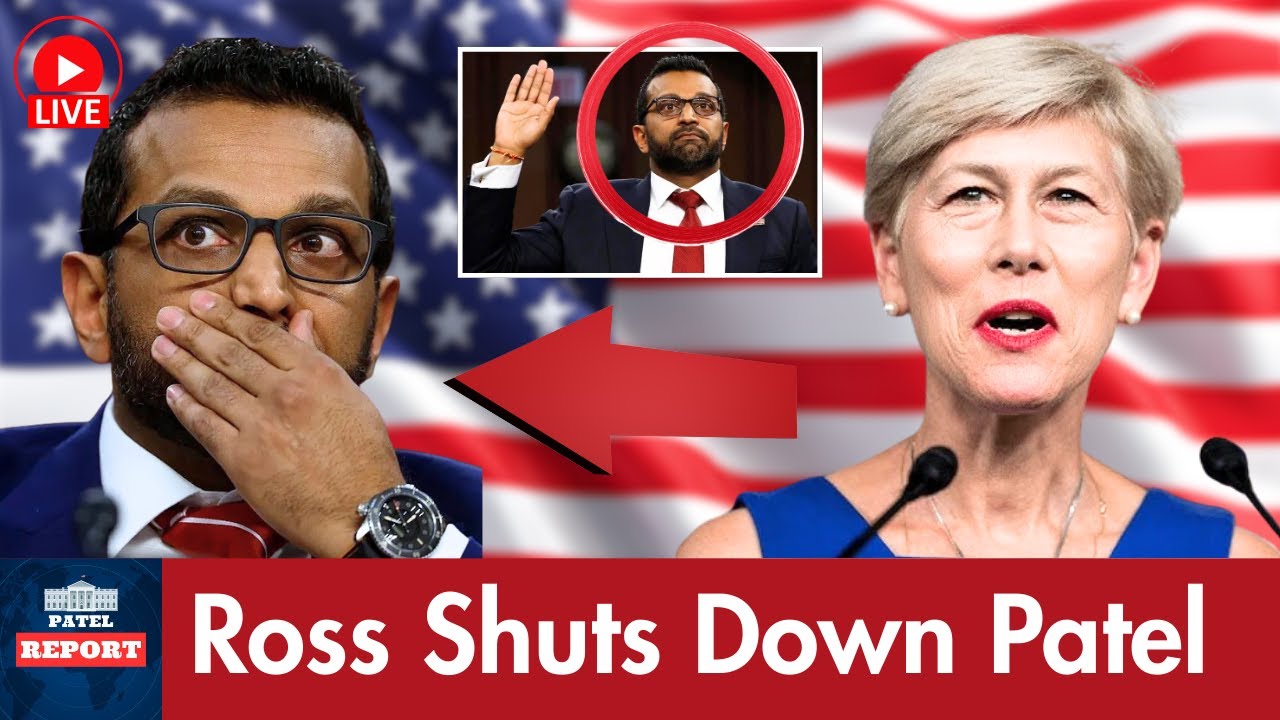
Rep. Ross DESTROYS Patel in 12 Minutes—”You Failed Your OWN Test” After 3 Agents Fired
Listen closely to the exact moment FBI Director Cash Patel realized he had walked into a trap he [music] couldn’t escape. It happened at 3:35 p.m. on March 20th, 2025, exactly 1 minute into Representative Deborah Ross’s questioning. She read his own words back to him. Words he had spoken under oath during his confirmation hearing just [music] 6 weeks earlier. words that promised no politicization, no retaliation, no firing agents for doing their jobs. And then she did something Patel never saw coming. She named three FBI agents, [music] three decorated professionals, three men whose careers Patel had destroyed for doing exactly what FBI agents are supposed to do, investigate crimes without political consideration. Brian Driscoll asked about his voting preferences, then fired when he refused to answer. Steve Jensen publicly praised by Patel himself as exemplary, then terminated eight weeks later for working January 6th investigations. [music] Walter Gardina, a war veteran who investigated Russian interference, removed after his cases touched Trump allies in just 12 minutes using nothing but documented evidence and prosecutorial precision. A former public defender from North Carolina would systematically destroy the credibility of the most powerful law enforcement official in America. and the weapon she used. Kash Patel’s own promises, his own standard, his own test. The test he would fail spectacularly before Congress, cameras, and the American people. But here’s what nobody expected. The reason Ross’ destruction of Patel was so complete, so devastating, so impossible for him to defend against wasn’t just the evidence she presented. It was the trap she built minute by minute, locking Patel into his own words before revealing each violation. By the time Patel realized what was happening, it was too late. The prosecutorial vice had closed, and there was nothing he could do except sit in silence for 18 excruciating seconds while C-SPAN cameras captured every moment of his inability to defend the indefensible. This is the story of how 12 minutes of methodical cross-examination exposed the systematic politicization of American law enforcement and why the phrase, “You failed your own test,” became the epitap of Cash Patel’s career. [music] March 20th, 2025, 3:34 p.m. House Judiciary Committee, Rayburn House Office Building. The fluorescent lights of the hearing room cast sharp shadows across Representative Deborah Ross’ face as she arranged three folders on the desk before her. Each folder contained a career, a life, a story of service and betrayal. She had spent weeks preparing for this moment, not as a politician seeking cable news sound bites, but as a former public defender preparing to cross-examine a witness who had already committed perjury. She just needed to prove it. FBI Director Cash Patel [music] sat behind the witness table in his perfectly tailored Navy suit, FBI pin gleaming under the lights. For three hours, he had deflected partisan attacks with practiced bureaucratic language, dismissed accountability questions with operational success statistics, and maintained the fiction that the FBI under his leadership operated with complete political independence. He looked comfortable, confident, like a man who believed he had survived the worst Congress could throw at him. He had no idea that the worst hadn’t even started yet. Deborah Ross had been taking careful notes throughout the hearing, occasionally nodding, never interrupting the partisan theater playing out around her. Other members had their moments, raised voices, accusatory questions, dramatic pronouncements for social media clips. Ross had [music] been waiting because she understood something fundamental about destroying credibility. You don’t do it with volume. You do it with precision. You let the witness commit to their lies. Then you prove methodically and irrefutably that every word was false. At 3:34 p.m., Chairman Jim Jordan recognized Representative Ross for her questioning time. The room’s energy shifted slightly. Congressional veterans knew Ross’ reputation. When she stood up with documents, someone was about to have a very bad day. “Thank you, Mr. Chairman,” Ross began, her voice carrying none of the confrontational edge that had characterized earlier questioning. It was calm, measured, almost gentle. The tone of a prosecutor who has already won and is simply walking the jury through the inevitable conclusion. Director Patel, I want to start by reading you something from your confirmation hearing. I think it’s important context. She lifted a transcript with deliberate care. The pages already marked with precise annotations. Patel shifted slightly in his chair. Reading from prior testimony was never a good sign. On February 3rd of this year, Senator Durban asked you directly about politicization of the FBI. Your response, and I’m reading your exact words, was this. There will be no politicization of the FBI under my leadership. No retaliation against agents for their work on specific cases. Personnel decisions will not be based on case assignments. The FBI will remain independent of political considerations. Ross looked up from the transcript, her eyes meeting Patel’s across the hearing room. Do you remember making that statement under oath, Director Patel? The question seemed simple, almost innocuous, but everyone in that room who understood courtroom dynamics recognized it as the first move in a prosecutorial trap. Ross was locking Patel into his prior testimony before he knew why she was asking. “Yes, Congresswoman,” Patel [music] replied, maintaining his confident posture. “And I stand by that commitment.” “Good,” Ross said. [music] and something in her tone suggested that standing by that commitment was the worst decision Patel could have made because I’d like to test that commitment against some specific cases. If [music] your statement was truthful, these cases should be easily explained. If it wasn’t truthful, well, we’ll see what we’ll see. The trap had been set. Ross had locked FBI Director Cash Patel into his own standard before Congress. Now she would systematically prove he had violated every promise. At 3:35 p.m., exactly 1 minute into her questioning, Ross shifted from abstract principles to devastating specifics. “Let’s start with Brian Driscoll,” Ross said, opening the first of three folders. “Are you familiar with that name, Director Patel?” Patel’s confident expression flickered. “Just slightly, just enough that trained observers could see the first crack in his armor.” “I’m familiar with many FBI personnel,” he deflected. Brian Driscoll specifically Ross Press, her voice sharpening with prosecutorial insistence. Approximately 20 years of FBI service, Medal of Valor recipient led the critical incident response group. Do you know who I’m referring to? The specific details eliminated any possibility of vagueness. Ross was establishing before Congress and cameras that this was a real person with documented service, not a hypothetical scenario or partisan talking point. I believe I know the individual you’re referencing, Patel conceded carefully. Excellent, Ross replied, though her tone suggested nothing was excellent about what was coming next. Mr. Driscoll filed a lawsuit currently in ongoing litigation, alleging that during a security review conducted by your administration, he was asked about his political preferences. Specifically, he was asked how he voted in the last election. When he refused to answer those questions, citing their obvious inappropriateness, [music] he was removed from his position. The specificity was surgical. Ross wasn’t making vague allegations. She had legal documentation that could be verified by anyone watching. [music] Lawsuit documents filed in federal court. A matter of public record. Congresswoman personnel decisions involve multiple factors that I cannot discuss in open session due to Patel began his standard bureaucratic deflection. I’m not asking about multiple factors, Ross interrupted, her voice, cutting through his evasion like a scalpel. I’m asking a very simple yes or no question. was Brian Driscoll, a 20-year FBI veteran and Medal of Valor recipient, asked about his political preferences and voting history during a security review. The yes or no demand eliminated all wiggle room. Patel had to either confirm the political questioning or deny allegations that were documented in federal court filings. [music] Security reviews can involve a range of questions designed to assess. Patel tried again. That’s not a no, Ross stated flatly. Her prosecutorial instincts fully engaged. In fact, your refusal to deny it confirms [music] it happened. A 20-year FBI veteran, a Medal of Valor recipient, was asked about his political views and voting preferences. Then, when he refused to answer those completely inappropriate questions, he was removed from his leadership position. You didn’t fail someone else’s test, Director Patel. You failed your own test. The phrase hung in the hearing room like a verdict from which there could be no appeal. Simple, [music] devastating, undeniable. The standard you’re being judged against isn’t mine,” Ross [music] continued, her voice carrying the weight of absolute moral authority. “It’s yours. The promises weren’t made to me. They were made under oath to the United States Senate during your confirmation. And the verdict, based on documented evidence, is clear. [music] You have politicized the FBI. You have retaliated against agents. You have made personnel decisions based on case assignments. Everything you promised wouldn’t happen has happened.” Ross opened the three folders one final time. Brian Driscoll’s career shouldn’t have ended because he refused to answer questions about how he voted. Steve Jensen’s decades of experience shouldn’t have been discarded because he investigated January 6th. Walter Gardina’s service to this country shouldn’t have been terminated because he investigated Russian interference. [music] Her voice carried both sadness and steel. These men served their country. They did their jobs investigating crimes and threats regardless of political implications. That’s exactly what FBI agents are supposed to do, and they were punished for it. That’s exactly what you promised wouldn’t happen. At 3:46 p.m., exactly 12 minutes after she began, Representative Deborah Ross yielded back her time. She had systematically destroyed FBI Director Cash Patel’s credibility using nothing but his own words, documented evidence, and prosecutorial precision. The aftermath was immediate and explosive. Within 5 minutes, you failed your own test was trending globally. Within an hour, news networks were playing the 12-minute segment on loop. Within 3 hours, the phrase had appeared in over 2 million social media posts. Three names, three broken promises, 12 minutes that changed everything, and one phrase that defined it all. You failed your own test. That test wasn’t created by partisan politicians or media critics. It was created by Cash Patel himself. When he raised his right hand and swore to the United States Senate that there would be no politicization, no retaliation, no personnel decisions based on case assignments. Deborah Ross simply held him to his word. Sometimes accountability is complex. Sometimes [music] it’s simple. Sometimes it just takes a former public defender with three folders, 12 minutes, and the courage to say what everyone knows is true. You made promises. You broke [music] them. You failed your own test. The visual media impact was devastating. News broadcasts displayed split screens showing Patel’s February confirmation promises side by side with March termination timelines. They showed his public praise of Steve Jensen dated March 14th next to headlines about Jensen’s removal in May. They captured and replayed in slow motion the 18 seconds of silence when Patel couldn’t deny asking Driscoll about his voting preferences. Legal experts across the political spectrum called it one of the most effective congressional examinations in modern history. This is [music] textbook prosecutorial cross-examination, noted former federal prosecutor Pit Barara. Ross locked Patel into his own standard, then methodically proved he violated it. There’s no defense against that. [music] The three names became instant symbols. Brian Driscoll, the Medal of Valor recipient, asked about his vote. Steve Jensen, praised then fired in 8 weeks. Walter Gardina, the war veteran removed for investigating Russian interference. Their stories represented something larger than individual cases. They represented the systematic politicization of American law enforcement. Democratic members of Congress immediately cited Ross’ questioning in renewed calls for Patel’s resignation. But perhaps more significantly, cracks began appearing in Republican support. Several GOP members, particularly those facing competitive re-election races, issued carefully worded statements expressing concern about the specific cases Ross had highlighted. The FBI Agents Association issued a statement within hours, the systematic removal of agents who work politically sensitive investigations as documented by Representative Ross represents a fundamental betrayal of the FBI’s mission and independence. Within 24 hours, three more FBI whistleblowers came forward with similar allegations. Each described political litmus tests during security reviews. Each described investigations being shut down when they touched Trump allies. Each described a culture of fear where agents understood that investigating certain people meant career destruction. By March 21st, calls for Patel’s resignation came from both parties. The phrase failed your own test had become shortorthhand for a specific type of corruption. The hypocrisy of officials who promise accountability while systematically violating their own standards. What made Ross’ destruction of Patel so complete was its simplicity. She didn’t need partisan rhetoric. She didn’t need complex legal theories. She just needed three names, three documented cases, and Patel’s own words from 6 weeks earlier. The hearing would be remembered as the moment when congressional oversight actually worked. When one prepared, precise member armed with documented evidence could hold power accountable. When 12 minutes of methodical questioning could expose what months of partisan theater had failed to reveal, “You failed your own test.” Five words that destroyed a career and exposed an institution. [music] Five words that proved sometimes accountability doesn’t require complex investigations or years of legal battles. Sometimes it just requires a former public defender with three folders, 12 minutes, and the willingness to present evidence, lock in lies, and prove truth. The standard Patel failed wasn’t someone else’s. It was his own. And that’s what made his failure impossible to defend, impossible to spin, and impossible to escape.