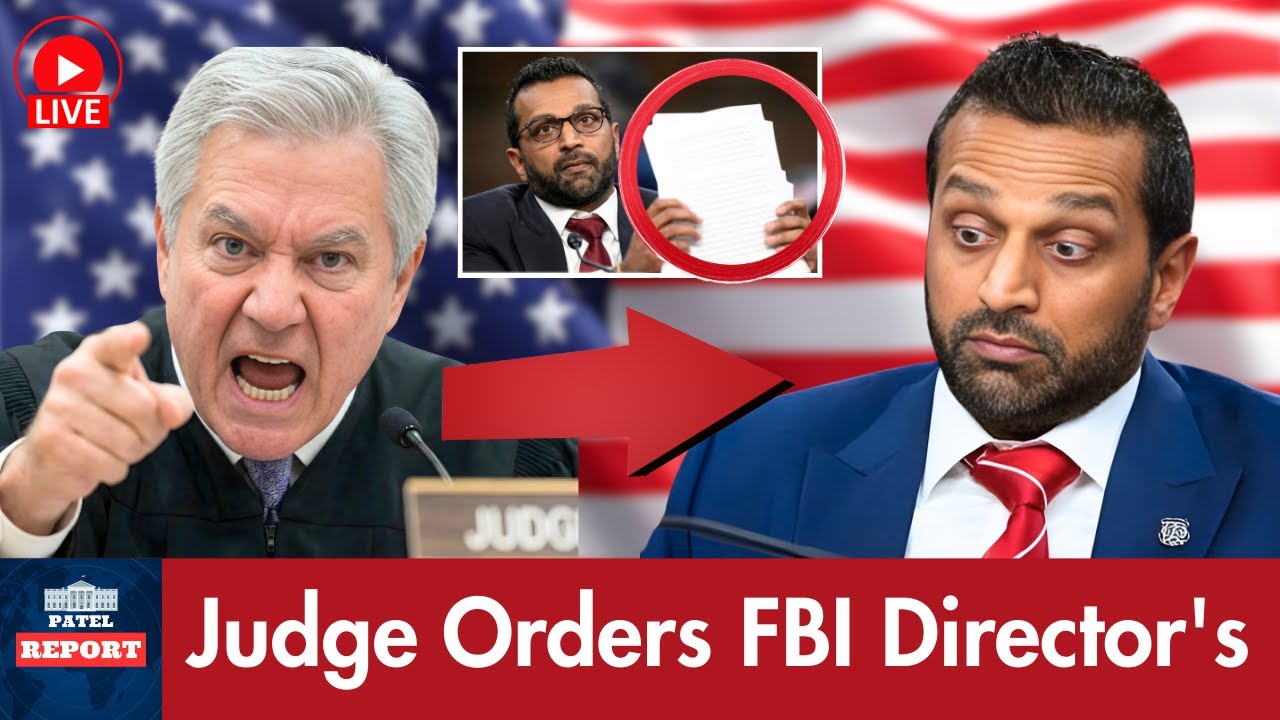
Judge Orders FBI Director’s IMMEDIATE ARREST—48 Hours Until Marshals Move In
Listen closely to the three words that will either end Cash Patel’s career or prove he’s untouchable. Immediate arrest threatened. Those three words spoken by federal judge Richard Bur on December 17th, 2025 at exactly 2:53 p.m. set a countdown clock that’s ticking toward the most explosive constitutional crisis in modern American history. 48 hours. That’s all Patel has before federal marshals walk into FBI headquarters with handcuffs and an arrest warrant signed by a federal judge who just told the nation’s top law enforcement officer that he’s going to jail. But here’s what nobody expected. The documents Patel is hiding. They’re not just about Jeffrey Epstein. They’re about who Epstein was working for. And that list includes names so powerful that even saying them out loud in a federal courtroom made Judge Burman pause. I’ll tell you exactly what those documents contain, but first you need to understand how we got to the moment where an FBI director is 48 hours away from being arrested by his own agents. December [music] 17th, 2025, 7 to District Court, Washington DC. The mahogany panled courtroom carried the kind of silence that comes before an execution. Judge Richard Burman sat behind the bench with the expression of a man who had run completely out of patience. 6 months of legal games. 6 months of privilege claims. 6 months of watching the FBI director [music] treat court orders like suggestions. Cash Patel sat at the defense table wearing his standard Navy suit and FBI pin. His legal team flanked him with briefcases full of objections. Patel had the look of a man who believed he was bulletproof. Trump’s most loyal appointment. The FBI director who had promised to burn down the deep state. But what Patel didn’t know was that Judge Burman had already prepared the arrest warrant. It was sitting in a manila envelope on the bench. All it needed was a signature and a time stamp. Director Patel, Judge Burman, began his voice carrying controlled fury. We are here today because you have systematically defied four separate court orders over the past 6 months. [music] Four orders directing you to release documents subpoenaed by Congress regarding FBI investigations into Jeffrey Epstein’s criminal network and its [music] connections to current and former government officials. The judge held up a thick file. Three federal courts, including the DC Circuit Court of Appeals, have reviewed your claims of executive privilege, attorney client privilege, and national security exemptions. All three courts have explicitly rejected every single claim you’ve made. Burman’s voice rose slightly. So, I’m going to ask you a direct question. Do you intend to comply with this court’s orders? Yes or no? Patel’s lead attorney stood. Your honor, the FBI maintains that. Sit down, counsel. Judge Burman’s voice cracked like a whip. I didn’t ask you. I asked Director Patel, “Director Patel, will you comply with this court’s order?” Yes or no? And that’s when Cash Patel made the decision that would put him 48 hours away from a jail cell. Your honor, Patel said. The FBI believes that additional review is necessary to ensure that no sensitive investigative methodologies are compromised. We need more time to stop right there. Judge Burman interrupted. That’s not an answer to my question. Yes or no? Will you comply? Patel hesitated. Just for a second, the moment of calculation. comply and expose what’s in those files or defy the judge and hope Trump can protect him. Your honor, we are working toward compliance, but we believe certain materials require additional consideration before that was all Judge Burman needed to hear. At 2:52 p.m., the judge reached for the Manila envelope and pulled out a document that would make headlines around the world within minutes. Director Patel, I want you to listen very carefully to what I’m about to say. The judge’s tone shifted. This wasn’t a warning anymore. This was sentencing. Based on your repeated refusal to comply with lawful court orders, I am prepared to hold you in criminal contempt of court under 18 US code section 401. The courtroom erupted in whispers. Criminal contempt, not civil contempt, which carries fines. Criminal contempt, which carries jail time. Oh, I absolutely would, Judge Burman said with devastating clarity. And I’m going to explain exactly how this is going to work. I am giving you a final deadline. December 20th, 2025 at 5:00 p.m. That is exactly 72 hours from this moment. You will deliver to this court in full and without redaction every document that has been subpoenaed and ordered released. But then, Judge Burman said the three words that would dominate every news cycle for the next 48 hours. If you fail to comply with this deadline, I will sign an arrest warrant for your immediate arrest on criminal contempt charges. Federal marshals will take you into custody. You will be held in federal detention until you purge your contempt by complying with this court’s orders. [music] The silence in that courtroom was absolute. A federal judge had just threatened to arrest the FBI director. There will be no hearing, Judge Burman continued. [music] There will be no appeal process before arrest at 5:01 p.m. on December 20th. If those documents have not been delivered, you will simply be arrested and jailed. Those are your only two options, Director Patel. comply or go to jail. But what happened next was even more shocking. Judge Burman pulled out another document. Director Patel, I’m also putting on the record that I have reviewed the classification status of every document you claim is [music] too sensitive to release. The director of national intelligence has submitted a sworn declaration to this court [music] stating that none of the subpoenenaed materials contain classified information. Patel’s face went pale. The DNI had just cut his legs out from under him. Furthermore, the judge continued, “I have reviewed your privilege log. The log you submitted claiming attorney client privilege deficient failed to establish any valid legal basis. The executive privilege claims already rejected by the Supreme Court in United States versus Nixon. You know, the case that established that no one, not even the president, is above the law. But then, Judge Burman revealed something that made even the most seasoned legal observers realize they were watching history being made. What’s particularly interesting, Director Patel, is the pattern this court has observed. While you claim you cannot release documents about Epstein’s network because of supposed national security concerns, you have somehow found time to authorize the selective release of documents targeting the current administration’s political opponents. That selective application of privilege claims suggests these are not good faith legal arguments. This is political obstruction. And then the judge asked the question that every American had been asking for months. Director Patel, what exactly are you hiding? And more importantly, who are you protecting? The question hung in the air because everyone in that room knew exactly who Patel was protecting. The same person who had appointed him. The same person whose connections to Epstein had been documented in dozens of photographs, flight logs, and witness statements. But Patel couldn’t answer that question because answering it would require admitting that he was using his position as FBI director to shield the former president from criminal investigation. So Patel said nothing and his silence was more damning than any confession. The FBI director has no authority to defy court orders. [music] Judge Burman stated none. Zero. The Constitution is very clear about separation of powers and judicial authority. Director Patel can claim executive authority all he wants. But when a federal court issues a lawful order based on constitutional authority, he must comply. Period. But what Judge Burman said next revealed the true scope of what’s at stake. And let me be clear about something else. I am prepared to refer this matter to every state bar association where Director Patel holds a law license. Willful defiance of court orders is grounds for professional discipline, including disparment. If Director Patel chooses to defy this court, he won’t just lose his freedom temporarily. He could lose his law license permanently. The stakes [music] had just become existential, comply, and potentially expose criminal conduct by the most powerful people in America, or defy the court and lose everything. freedom, [music] career, reputation, legacy. By the time Judge Burman adjourned the hearing at 3:15 p.m., the deadline had been set. [music] December 20th, 5:00 p.m., 72 hours until federal marshals would either be standing down or putting handcuffs on the FBI director. [music] But here’s what makes this deadline even more explosive. December 19th, exactly 1 day before Patel’s compliance deadline, a separate court order requires the release of another batch of Epstein files. Files that reportedly contain victim testimony. flight logs and evidence that FBI agents had recommended criminal investigations of multiple high-profile individuals, investigations that were killed by political appointees. Think about [music] the timing. December 19th, public release of explosive Epstein evidence. December 20th, Patel either releases everything or gets arrested. The two events aren’t coincidental. They’re designed to create maximum pressure. And here’s the question that legal experts are asking. What happens if Patel is arrested and then Trump tries to intervene? What if Trump issues an executive order declaring the arrest unlawful? The answer is both simple and [music] terrifying. Constitutional crisis. The judiciary versus the executive branch in direct confrontation. The kind of crisis that has historically preceded authoritarian takeovers or constitutional collapse. But Judge Burman seems prepared for that scenario, too. His December 17th ruling included language specifically addressing potential executive interference. He cited Nixon president and made clear that any attempt to interfere with judicial process would itself be grounds for contempt charges against anyone involved up to and including the president. [music] The judge essentially dared Trump to try it and based on Trump’s history of backing down when real legal consequences appear. There’s reason to believe he might abandon Patel rather [music] than risk his own criminal exposure. So, we’re watching a chess game play out in real time. [music] Patel betting that Trump will protect him. Trump calculating whether Patel is worth the political and legal cost. Judge Burman positioning the law itself as the ultimate authority that neither can escape. 48 hours left. The documents are still hidden. The arrest warrant is prepared. Federal marshals are on standby. And somewhere in FBI headquarters, Cash Patel is making the most important decision of his life. Comply and expose what might be the biggest political scandal in American history. or defy the judge and become the first FBI director ever jailed for contempt, cementing [music] his place in history for entirely different reasons. December 20th, 5:00 p.m. One deadline, two [music] choices, no middle ground. But there’s something else you need to know. Something that makes this entire situation even more explosive. While Patel was sitting in that courtroom being threatened with arrest, something else was happening three blocks away at FBI headquarters. At 3:47 p.m. on December 17th, [music] just 32 minutes after Judge Burman adjourned the contempt hearing, FBI technical staff received an unusual order. According to a whistleblower who contacted congressional investigators, senior officials in Patel’s office requested an emergency review of document storage protocols for sensitive files related to closed investigations. The timing wasn’t coincidental. The [music] whistleblowers account suggests that Patel might be preparing a final strategy. If he can’t win in court, if he can’t delay the deadline, if Trump can’t protect him through political means, there’s one last option. [music] Technical failure, files that mysteriously become corrupted, storage systems that malfunction, documents that are accidentally overwritten during routine maintenance procedures. [music] It’s happened before. Remember when the IRS claimed years of Lois Learner’s emails were lost due to hard drive crashes? Remember when the CIA accidentally destroyed interrogation tapes? Technical failures are the ultimate bureaucratic [music] defense because they’re nearly impossible to prove were intentional. But here’s why that strategy might not work this time. Judge Burman anticipated it. During the December 17th hearing, he issued a specific order that didn’t get much media attention, but might be the most important part of his ruling. He ordered the FBI to provide by end of business December 18th a complete forensic audit of all systems containing the subpoenaed documents, third-party verification, independent technical examination, a paper trail showing that every file exists and is retrievable. If Patel claims technical failure on December 20th, the judge will have evidence showing whether that failure is legitimate or manufactured. And if it’s manufactured, [music] that’s not just contempt. That’s obstruction of justice with evidence destruction. a federal crime that carries significant prison time. So Patel’s options are narrowing. He can comply and release the files. He can defy the judge and go to jail. Or he can try to destroy evidence and face criminal prosecution that even a presidential pardon might not resolve since it could be charged in state court for destruction of evidence in state investigations. The trap is complete and Patel walked right into it. December [music] 18th, 24 hours after the contempt hearing, Patel still hasn’t indicated any intention to comply. His attorneys are reportedly exploring every possible avenue to delay or avoid the deadline, but they’re running out of options. Emergency appeals to hire courts have been rejected. Requests for deadline extensions have been denied. The clock is ticking and the political fallout has already begun. Democrats are calling for Patel’s immediate resignation, arguing that an FBI director who defies court orders has no legitimacy to lead federal law enforcement. Some Republicans, particularly those who face competitive races in swing districts, are quietly distancing themselves from Patel, unwilling to defend obstruction of justice on national television. But the Trump base is rallying around Patel. They see this as another example of the deep state trying to destroy a loyal Trump appointee. They argue that Patel is protecting sensitive information from politically motivated attacks. They claim the judge is overstepping constitutional boundaries. The problem with that argument, [music] three separate federal courts have already rejected every legal claim Patel has made. These aren’t [music] politically motivated rulings. These are unanimous decisions based on clear precedent and constitutional law. 48 hours until we find out whether the American justice system can still hold powerful people [music] accountable or whether we’ve reached the point where officials can simply ignore the law when it’s [music] politically convenient. 48 hours until we find out if Cash Patel complies and exposes what he’s been hiding [music] or if he becomes the first FBI director in American history to be arrested and jailed for contempt of court. 48 hours until federal marshals either stand down or walk into FBI headquarters with handcuffs. The countdown is on and based on everything we’ve seen, neither side is backing down. The clock is ticking.