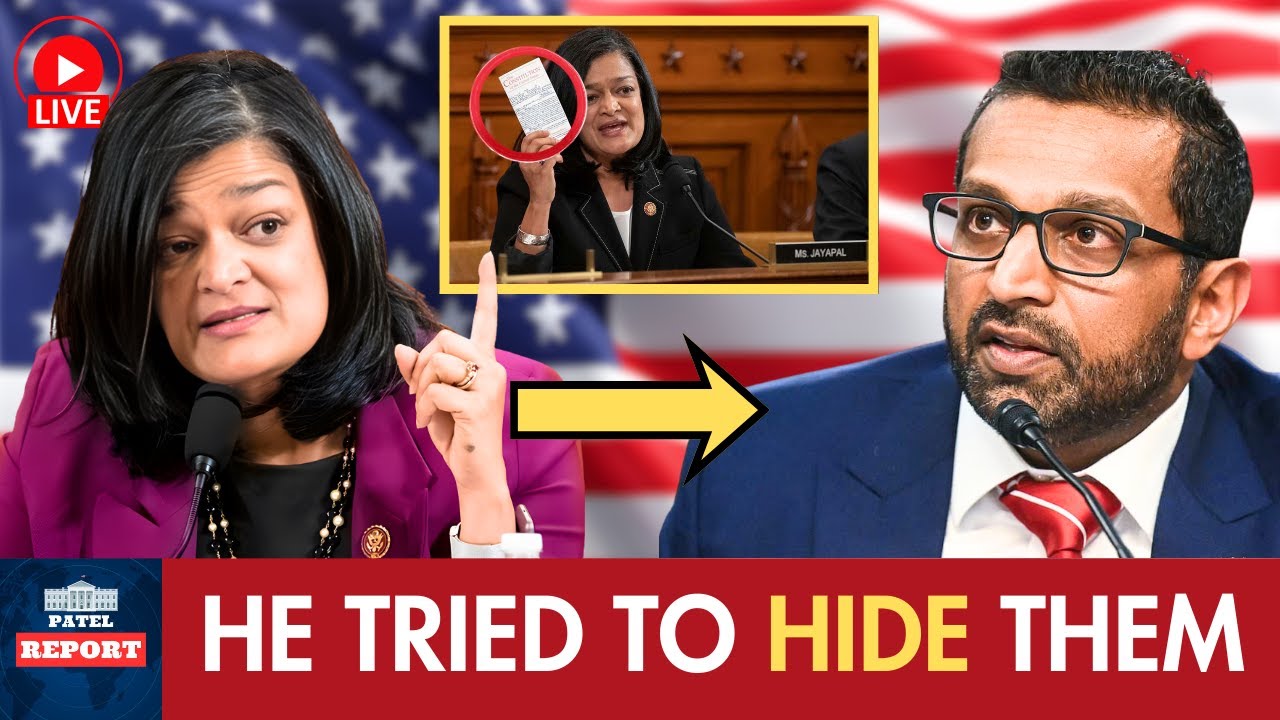
Pramila Jayapal EXPOSED The 47 Names Kash Patel Is HIDING
I never thought I’d see Primila Jaipal make an FBI director physically shake. Four minutes ago, in a packed House Judiciary Committee hearing room with cameras from every major network pointed at the witness table, the Congresswoman from Washington’s 7th district asked a question so direct, so cutting that Cash Patel’s hands visibly trembled when he reached for his water glass. Director Patel, she said, her voice calm but loaded with something dangerous. How many names are in the Epstein files that you personally redacted? Not your staff, not the classification team. You the room went silent. That kind of dead silence where you can hear the air conditioning hum and the camera’s autofocusing because everyone in that room knew what that question really meant. It meant Gyipal had proof. And Patel knew it, too. You could see it in his face. Let me back up. House Judiciary Committee oversight hearing, the 22nd of January, 2026. This was supposed to be routine FBI budget discussions, cyber security updates, maybe some back and forth about immigration enforcement, standard congressional theater. Republicans would praise Patel. Democrats would criticize him. Everyone would read their prepared statements and go home. That is not what happened. Primila Jipal walked into that hearing room with a thin blue folder. I noticed it immediately because Gyipal doesn’t usually bring props to hearings. She is known for her razor sharp memory, her ability to quote testimony from months ago without looking at notes. The folder meant something specific, something documented, something she wanted everyone to see. The first two hours went as expected. Republican members lobbed softball questions about FBI successes. Democratic members pressed on civil liberties concerns. Patel gave his practiced answers. That smooth bureaucratic tone that sounds like transparency but says nothing. Then Japal got her turn. Director Patel, she began opening the blue folder with deliberate slowness. I want to discuss the Epstein investigation files that were released last month. The temperature in the room dropped. Epstein questions always do that. But there was something different in how Jipal said it. Not angry, not theatrical, just precise. Like a surgeon announcing where she is about to cut. Patel shifted slightly in his chair. Congresswoman, as you know, we’ve committed to unprecedented transparency regarding those files. We released over,200 pages of previously classified material. That is not what I asked. Jaipal’s interruption was surgical. She didn’t raise her voice. Didn’t need to. I asked about the files you redacted. Not the files you released. The files you personally kept hidden. Here is where it got interesting. Patel’s three lawyers sitting directly behind him all leaned forward at exactly the same time. It was like watching a choreographed dance of panic. They knew something was coming. Congresswoman Patel said his voice steady but his right hand moving toward the table edge. I don’t personally make redaction decisions on individual documents that is handled by career classification specialists according to established protocols. Gyipal pulled out a single sheet of paper from her blue folder. She held it up just long enough for the cameras to see the FBI letter head. The classification stamps the official seal. This is an internal FBI memorandum dated the 3rd of November 2025. Subject line classification review override authority. She paused. Let me read you something. Director, she put on reading glasses. Gyipal never wears glasses in hearings. Never. The glasses meant she wanted everyone to know this was verbatim, documented, unfiltered truth. Quote, “Upon review of the Epstein investigation document release, FBI Director Cash Patel has personally flagged 47 witness testimony files for permanent classification override. These files contain direct testimony naming individuals in positions of significant political and financial influence. Standard declassification protocols have been suspended pending director’s personal authorization.” End quote. She looked up signed by your deputy director of counter intelligence. The room exploded. Not literally, but close. Whispers erupted across the gallery. Journalists were frantically typing. Republican members looked at each other with expressions ranging from confusion to alarm. Patel’s face went through three distinct changes in about 5 seconds. First, shocked that she had the memo. Second, rapid calculation about how to respond. Third, something that looked a lot like fear. Congresswoman, that memo is being taken out of context. Then put it in context. Gyipol’s voice was ice. Explain to me and to the American people watching why you personally blocked the release of 47 witness testimonies that name powerful individuals connected to Jeffrey Epstein’s crimes. 47 witnesses director 47 people who came forward who testified to the FBI who names and you decided the public doesn’t get to know what they said. Patel tried to recover with bureaucratic language. The classification process involves complex considerations of national security, ongoing investigations and witness protection protocols that I didn’t ask about the process. Jaipal cut him off, never raising her voice, never needing to. I asked why you personally overrode the declassification. This memo says you flagged them. You suspended standard protocols. So I am asking directly, Director Patel, what are you hiding? The question hung in the air like smoke after a gunshot because that is what it was. A direct accusation, not implied, not suggested, stated. What are you hiding? Patel’s mouth opened, closed, opened again. His lawyers weren’t passing notes. They were frozen. This wasn’t something they’d gained out in prep sessions. Chairman, I’d like to request a brief recess to gather the specific documents that would allow me to respond comprehensively to Representative Gyipal’s questions. Request denied. That was Jim Jordan, Republican chairman, Patel’s supposed ally. The shock on Patel’s face was visible even from the press gallery. Director Jordan continued, “If Representative Gaia Paul has an FBI memo showing you personally blocked witness testimony releases, I think we’d all like to hear your explanation right now.” Here is where Patel made his critical mistake. He tried to turn it into a partisan attack instead of answering the question. Congresswoman Gaia Paulal, I find it concerning that there seems to be more interest in attacking the FBI’s classification decisions than in supporting our ongoing work to Gyipal didn’t let him finish. She pulled out another document. Director Patel, do you know what this is? It is a letter from the Department of Justice Inspector General dated the 15th of December, 2025. She began reading, “The Inspector General has reviewed FBI Director Patel’s classification override decisions regarding Epstein investigation files. We have identified multiple instances where witness testimony was flagged for permanent classification despite containing no information that meets established criteria for national security exemption. She looked directly at Patel. The inspector general reviewed your decisions director and they found you violated your own classification standards. You blocked the release of testimony that had no legitimate national security justification. The room was chaos now. Democrats were demanding answers. Republicans were trying to figure out how to spin this and Patel just sat there visibly sweating under the committee room lights. Let me be specific. Gyipal continued, her voice cutting through the noise. Witness testimony file 2847. A a woman who worked at Epstein’s New York residence in 2009. She named seven individuals she personally witnessed at the property. None of those individuals work in intelligence. None have government security clearances. None pose any national security risk. Yet you classified her testimony as permanently restricted. Why? Patel’s voice came out strained. I don’t have the specific file details in front of me. Gyipol pulled out another sheet. I do, she read slowly, making sure every word landed. The witness described seeing a prominent technology executive, a British royal family member, a Hollywood studio head, two hedge fund managers, and a former US senator. She provided dates, descriptions, and offered to testify in court. She paused and you buried her testimony. Director, you made sure the American people would never see what she said. Not because of national security, because the people she named are too powerful to expose. That is not accurate. Patel’s voice was barely steady. Then correct me. Tell me which part is inaccurate. Tell me why this woman’s testimony needed to be permanently classified. Tell me who you are protecting. Silence. 20 seconds of complete silence. In congressional hearings, 20 seconds is an eternity. It is a confession without words. Finally, Patel spoke. The classification decisions were made in consultation with multiple agencies, intelligence community partners, and legal advisers who determined that public release could compromise Jaipal interrupted with devastating precision. Director, I have the classification review notes right here. She held up another document. Your deputy director of counter intelligence wrote, and I quote, “Director Patel has personally reviewed witness files 2847 A through 2893 C and has determined that despite no intelligence equities, public release would create unacceptable political complications.” She let that sink in. Political complications, director, not national security threats, not intelligence risks, political complications. That is why you had 47 witness testimonies because the truth would be politically complicated. Patel tried one more deflection. Congresswoman, you are reading internal deliberative communications that don’t reflect the final. They reflect exactly what happened. Gyipol’s voice was sharp. Now you were appointed FBI director on the promise of transparency. You told the American people the Epstein files would be released. You stood before this committee and swore. You’d exposed the truth. And then you personally blocked 47 witnesses from being heard because they named people you decided were too important to investigate. The accusations were piling up now, one after another, each one backed by documentary evidence pulled from that blue folder, and with each new document, Patel shrank a little more in his seat. But Gyipal wasn’t finished. She pulled out one more sheet of paper, and this one changed everything. “Director Patel,” she said, her voice now carrying absolute moral authority. “Do you recognize this name?” She held up the paper. Maria Santos, 19 years old, when she was trafficked by Jeffrey Epstein. She testified to the FBI in 2010. She named six men who assaulted her. Six men who she can identify, who she can describe in detail, who she is willing to testify against in court. Gyipal’s voice cracks slightly. The first real emotion she’d shown, you classified her testimony as permanently restricted. Maria Santos is now 34 years old. She has waited 15 years for justice and you decided that the men she named were more important than her right to be heard. The room was absolutely still because this wasn’t about bureaucracy anymore. This wasn’t about classification protocols or political complications. This was about a woman who was trafficked as a teenager and an FBI director who buried her testimony to protect her abusers. Director Patel Gyipal said, “I’m going to ask you one final question and I want you to look at the cameras while you answer because Maria Santos is watching and thousands of survivors are watching and the American people are watching.” She paused. “Why did you decide that protecting powerful men was more important than giving Maria Santos justice?” Patel had nothing. No answer, no deflection, no bureaucratic escape hatch. He just sat there, his hands trembling slightly, his face pale under the lights. “Congresswoman,” I started, but his voice failed. “I think that answer says everything we need to know,” Gyipal said quietly. She closed her blue folder. “Mr. Chairman, I have no further questions, but I do have a motion. I move that this committee subpoena all 47 witness testimony files that Director Patel personally classified along with all communications regarding those classification decisions and all records of FBI contact with the individuals named in those testimonies. The hearing devolved into procedural chaos after that motions and counter motions parliamentary procedure but none of that mattered. What mattered was the clip. The four minutes when Primila Gyipal systematically dismantled Cash Patel’s credibility using his own memos, his own classification decisions, his own words. Within an hour, the footage was everywhere. Gyipol exposes Patel’s Epstein cover. Uptrended worldwide, conservative outlets were scrambling. Liberal outlets were calling for resignation. And somewhere, Maria Santos was finally being heard. The blue folder became a symbol. 47 witness testimonies. 47 survivors who named their abusers. 47 files that Cash Patel decided to bury. Not for national security, for political complications. I’ve covered Congress for years. I’ve seen tough questioning. I’ve seen explosive confrontations. But I’ve never seen anything quite like what Primila Gipol did in those four minutes. She didn’t yell, didn’t perform, didn’t create sound bites. She just methodically, precisely, devastatingly proved that the FBI director lied. And she did it with documents, with names. With one 19-year-old trafficking victim who waited 15 years for someone to care, Cash Patel walked out of that hearing knowing his career was over, not because of partisan attacks, because a Democratic congresswoman asked him to explain why he protected powerful predators instead of their victims. And he had no answer. 4 minutes. That is all it took. 47 files, one blue folder, and a question Patel couldn’t answer. Why did you choose power over justice? The clip is still spreading. The subpoenas are being drafted and Maria Santos finally has someone fighting for her. Sometimes accountability doesn’t require hours of testimony or months of investigation. Sometimes it just requires one person willing to ask the questions nobody else will. Primila Gyipol asked and Cash Patel’s silence answered